
I’ve been absorbing books on family ministry since the first Christian bookstores started popping up in the 1990s. The first one hit me like a ton of bricks as a mom freezing in New England my first winter. The cover was red, I think it was by Tim Kimmel, and as a new mom I was on a mission to make sure my two littles, preschoolers at the time, would always know the Lord’s presence and directing for their whole lives.
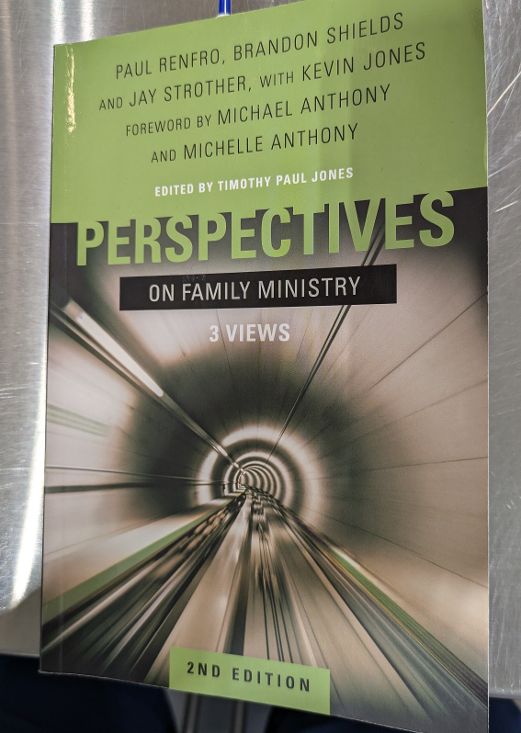
If you are thinking of expanding or growing your ministry with children into a Family Ministry Model, have I got a book and guide for you! As a student of the Family Ministry Academy by Renewanation, the first book to read and report on is Perspectives on Family Ministry, 2nd edition by Paul Renfro, Brandon Shields and Jay Strother, with Kevin Jones. This paperback uses its full 222 pages to share three family ministry models as well as the celebrations and challenges of all three. It’s the best book on family ministry in layman’s terms I’ve ever read to offer clear, concise vocabulary, definitions, and what family ministry is not.
Within the two parts, Perspectives lays out the foundations for Family Ministry with a historical context with definitions of Family Ministry, followed by the practices of three models for ministry with families.
- Family- Integrated Ministry Model – nearly all age-level classes and events are eliminated; aka family-driven or family discipleship approach; best practices are clearly presented in Voddie Baucham’s Family-Driven Faith.
- Family-Based Ministry Model – congregation still maintains youth ministry, children’s ministry, senior ministry, and so on coupled with additional intergenerational activities, curricula, and events with each ministry sponsoring faith formation experiences designed intentionally to draw generations together; best practices are clearly presented in Mark DeVries Family-Based Youth Ministry which also equips families to care for spiritual orphans.
- Family-Equipping Ministry Model – age-level ministries remain intact ‘yet church leaders plan every ministry to champion the place of the family as a primary unit for discipleship and the place of parents as primary disciple-makers in their children’s lives’; when the church equips parents to disciple their children, and parents see the church as an active partner in the process; the church and home as co-champions.
There are a lot of voices speaking in this book in support of each model and graciously exposing the challenges that each model presents. As I read and re-read this resource I felt better equipped to define the goals of the family ministry I lead and offer clear measurables for transformational impact which we call ‘fruitful celebrations’.
As more and more local churches are drawn to a family ministry model of faith formation in areas which have been typically siloed, this is one of the best resources for those who are keepers of the vision and the stories as the local church seeks to equip families to love the Lord with their whole hearts for their whole lives.
Which family ministry model are you striving for?
“The mission of family ministry in today’s world is to accurately handle the word of truth while teaching a new generation the timeless message of hope and redemption.” Dr. Michael Anthony and Dr. Michelle Anthony, Perspectives on Faith Ministry, forward, pg xx
 DeDeBullReilly